The canonical startup sequence is linear and famous: find product-market fit, then scale. Find it once. Protect it. Pour fuel on it. That mental model is load-bearing for an enormous number of decisions — when to raise, when to hire the go-to-market team, when to open new channels. All of it keys off the assumption that once you've found fit, it stays found. In 2026, that assumption is the problem.
PMF is a temporary state now
The Indie Hackers 2026 analysis, drawing on Robert Moment's Product Market Fit Is Expiring, names the shift directly: PMF is no longer a permanent achievement. It is a temporary state — and it is expiring faster than at any point in startup history.
This isn't a flourish. It's the connective tissue under the failure data. The single most-cited cause of startup death is no product-market fit, with 34–42% of failures tied to its absence. The expiration thesis adds the part that catches founders off guard: a meaningful share of those failures aren't companies that never found fit. They're companies that found it, then lost it while operating as if the milestone were permanent. You don't get a notification when your fit expires — revenue keeps coming from the cohort that already bought, the dashboard looks fine, and by the time it's legible you've spent two quarters scaling a fit that was already eroding.
The moat moved from product to positioning
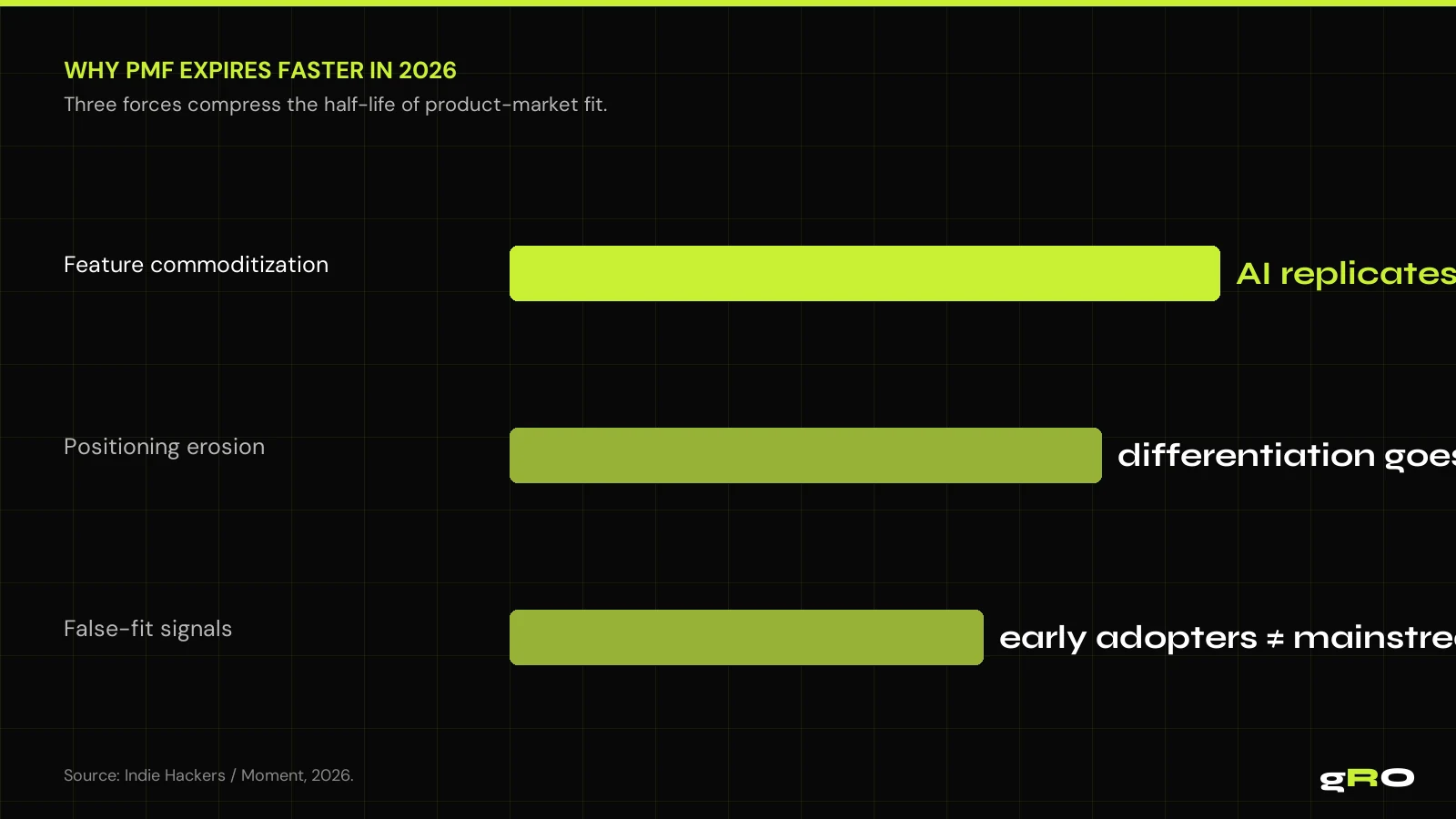
Three forces, all sharper in 2026, compress the half-life of fit. Feature commoditization: unique features become table stakes faster than ever as AI-native alternatives replicate them. Positioning erosion: founders cannot clearly articulate how their product differs from AI-native alternatives — differentiation that was sharp last year reads generic this year. False-fit signals: early adopters who don't represent the mainstream flatter you into believing fit is more durable than it is.
The first two are direct consequences of the AI shift running through this whole series. When execution and feature-building are commoditized, the moat that product features provided erodes faster — and the burden of fit shifts onto positioning, ICP precision, and demand-reading, which are exactly the things that decay quietly.
Scaling a fit that's already eroding
The most expensive place to hold the old \"find it once\" model is the $1M–$10M ARR stretch — the exact band where founders have some validated fit and are under the most pressure to scale on top of it. This is where the expiration thesis meets the survival curve: the brutal year-2-to-5 failure window is populated by companies that scaled a motion whose fit was lapsing underneath them.
Note the boundary with the staffing argument. The question \"have you proven the curve before you staff it?\" is about sequence and cost — covered in Prove the Curve. Then Staff It. The question here is different and prior: is the fit you're about to scale still real, or is it the one you found eighteen months ago? You can get the staffing sequence perfectly right and still scale into expired fit. Both have to be true.
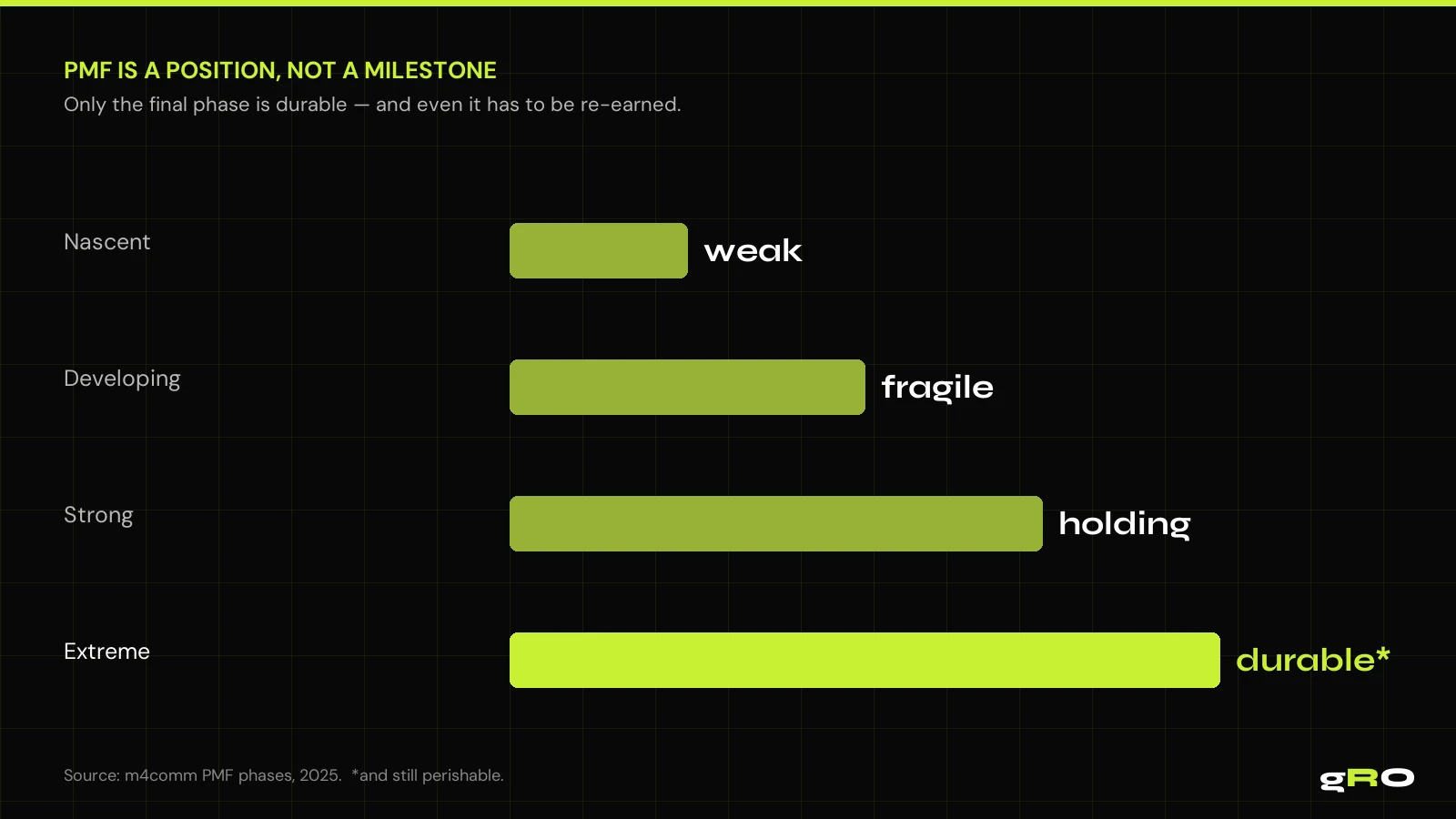
PMF as a maintained position
- Re-test fit on a cadence, especially as AI-native competition resets the category around you.
- Defend positioning actively. When features commoditize, differentiation has to be re-articulated, not assumed.
- Separate representative demand from early-adopter noise. Build the read that tells you which signal you're scaling on.
- Revisit pricing as perceived value moves. Pricing errors are a named killer.
- Scale only the fit that's current. Pour fuel on the motion validated now — not eighteen months ago.
Someone whose job is the loop
A maintained-PMF discipline needs someone whose job is exactly that loop — and that's the Operator-Led Growth model. One senior operator owns positioning, ICP precision, offer and pricing framing, analytics, and weekly optimization, with an AI agent fleet absorbing execution volume. The operator's judgment goes where fit erodes: differentiation, representative-demand reading, and the continuous re-test the expiration thesis demands.
Its weekly optimization cadence is the re-test loop — a standing read of what the market responds to now, which is how you catch fit lapsing before it shows up as softening conversion. If you can't say, with current evidence, that the fit you're scaling on is still real, that's the question to answer before you add another dollar or head.
Sources cited in this analysis
- Indie Hackers — Top 100 Startup Failure Statistics 2026 (\"Product Market Fit Is Expiring,\" Robert Moment)
- m4comm — Mastering Product-Market Fit: A Startup's Guide to Growth in 2025 (PMF phases; 34–42% figure)