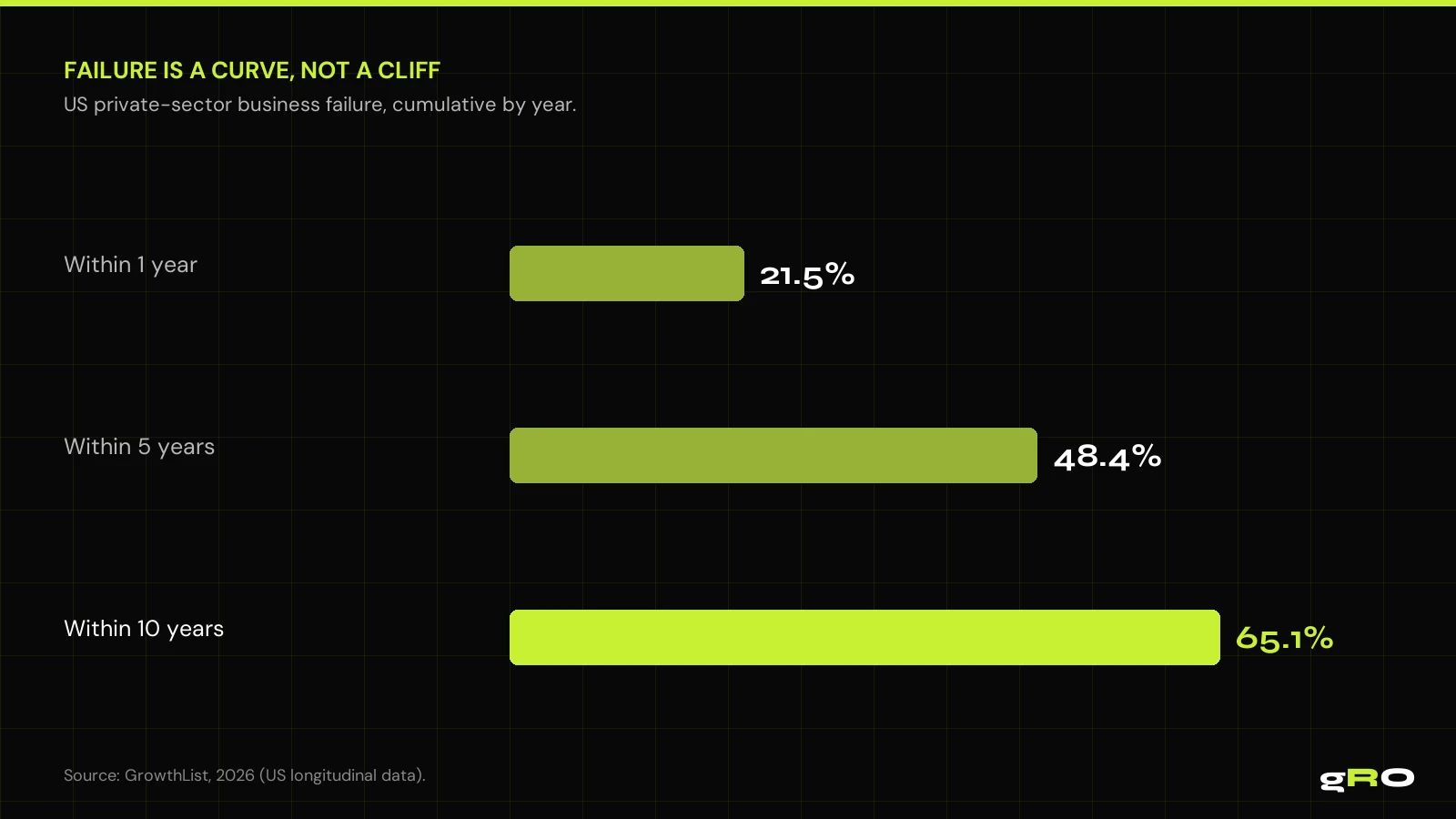
You've heard that 90% of startups fail. It's the most-repeated statistic in the industry, and it's directionally true — but it's a blunt instrument that tells a founder nothing actionable. Why they fail is the part that changes decisions. The more precise picture, from US private-sector data, is a survival curve: about 21.5% fail within year one, 48.4% within five years, 65.1% within ten. And these rates have been roughly stable since the 1990s — the first clue that the cause isn't technical. If failure were a technology problem, three decades of radically better tools would have moved the curve. They didn't.
The brutal stretch is years two through five
Year one takes ~21.5% — often pre-revenue ideas that never found a buyer. But the brutal stretch is years two through five, where the cumulative rate climbs to 48.4%. That's the window of companies that did get something working, raised a little, hired a little, started to scale — and then discovered the thing they were scaling wasn't solid.
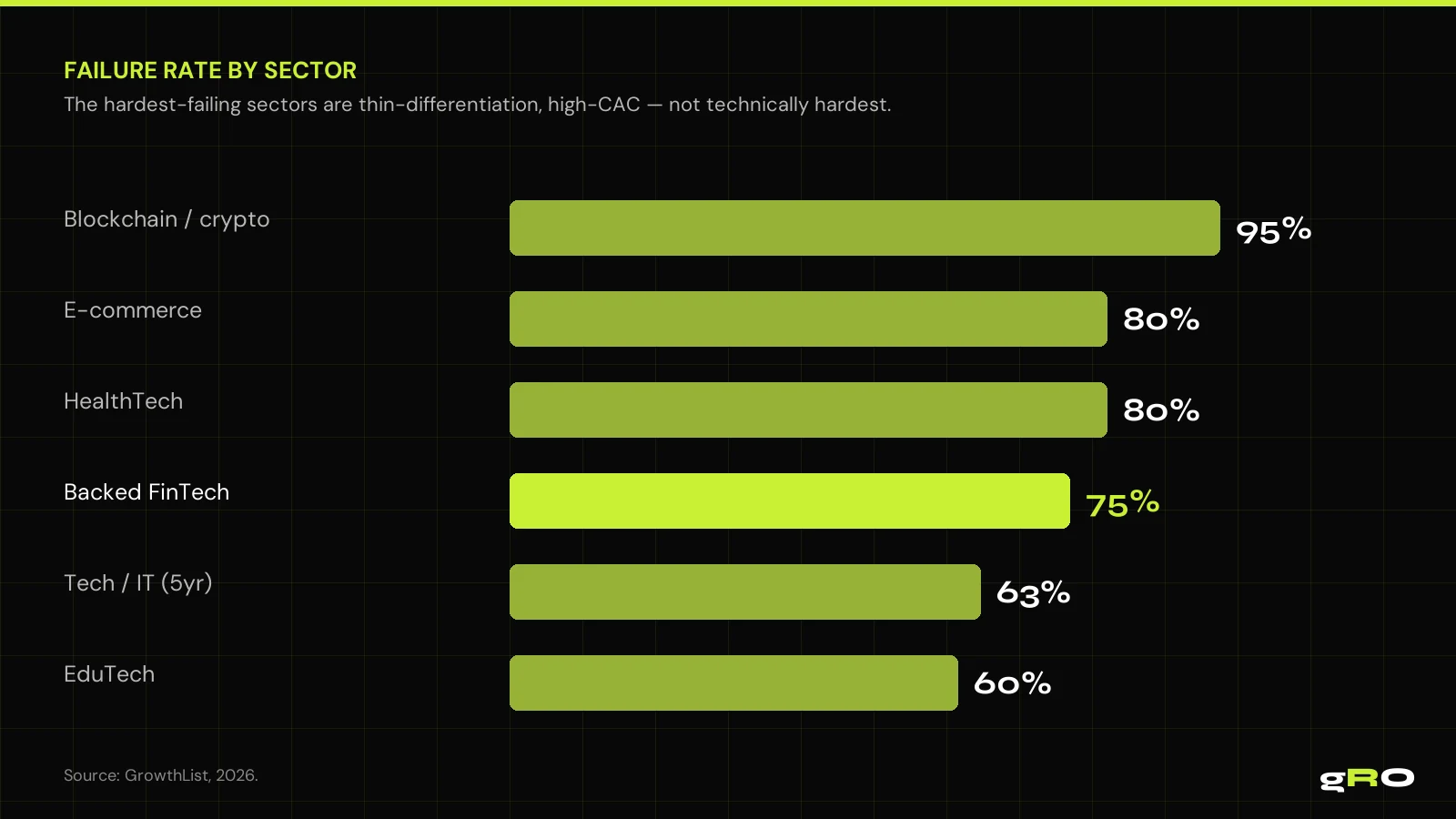
Industry rates sharpen the point. The sectors that fail hardest are the ones with thin differentiation and high acquisition cost, not the ones that are technically hardest. Even venture-backed FinTech fails 75% of the time. Capital didn't save them. Whatever kills startups operates upstream of funding.
It's not the code
When you read the cause analysis instead of the rate, the same answer appears across every dataset. As the Indie Hackers 2026 compilation puts it bluntly: \"Startup survival is not primarily a technical problem. It is a strategic and market-alignment problem.\"
The most-cited single cause, everywhere, is no product-market fit — one analysis attributes 34–42% of failures to it alone. The rest of the top of the list is striking for what it is not: pricing-strategy errors, poor positioning, ignoring customer feedback, premature scaling, false PMF signals from non-representative early adopters. Every item is a go-to-market failure — who you're for, what you say, what you charge, when you scale. The product is rarely the corpse. The market alignment around it is.
Dying of the cure
The most preventable killer on the list is premature scaling — pouring spend and headcount into a motion before the underlying fit is proven. It's cruel because it feels like progress. You raised, so you hire. You hire, so you spend. The org chart grows, the burn grows, and the gap between activity and validated demand grows with it.
It connects directly to the funding climate (see The Funding Records Are a Trap): a founder who reads the record-year headline and scales into it — before pricing, positioning, and real PMF are nailed — is manufacturing the exact failure mode the data flags most often. The cure for slow growth becomes the cause of death.
What actually survives
- Nail positioning and ICP before scaling spend. The most-cited cause of death is fixable upstream, with judgment, not headcount.
- Price to perceived value, and revisit it. Pricing errors are on the kill list — and among the fastest things to correct.
- Read real demand, not flattering noise. False-PMF signals from non-representative early adopters are a named cause.
- Prove the motion before you scale it. Premature scaling is preventable by definition.
An accountable owner on the causes of death
The causes of startup death are precisely the surface area Operator-Led Growth is built to own. One senior operator takes the full growth function and applies senior judgment to exactly the levers the failure data implicates: ICP clarity, positioning, offer framing, and reading genuine demand versus noise. AI absorbs the execution volume so the judgment can go where it matters.
It puts an accountable owner on the most-cited causes of death, enforces prove-before-scale by design (diagnosis first via the Funnel Audit, spend second), and treats PMF as a maintained state through weekly optimization. If you can't name, today, which failure cause is closest to your funnel, that uncertainty is the risk.
Sources cited in this analysis
- GrowthList — Startup Failure Statistics 2026 (failure rates by year and sector)
- Indie Hackers — Top 100 Startup Failure Statistics 2026 (causes; \"PMF is expiring\")
- m4comm — Mastering Product-Market Fit: A Startup's Guide to Growth in 2025 (34–42% PMF figure)